What is on disk
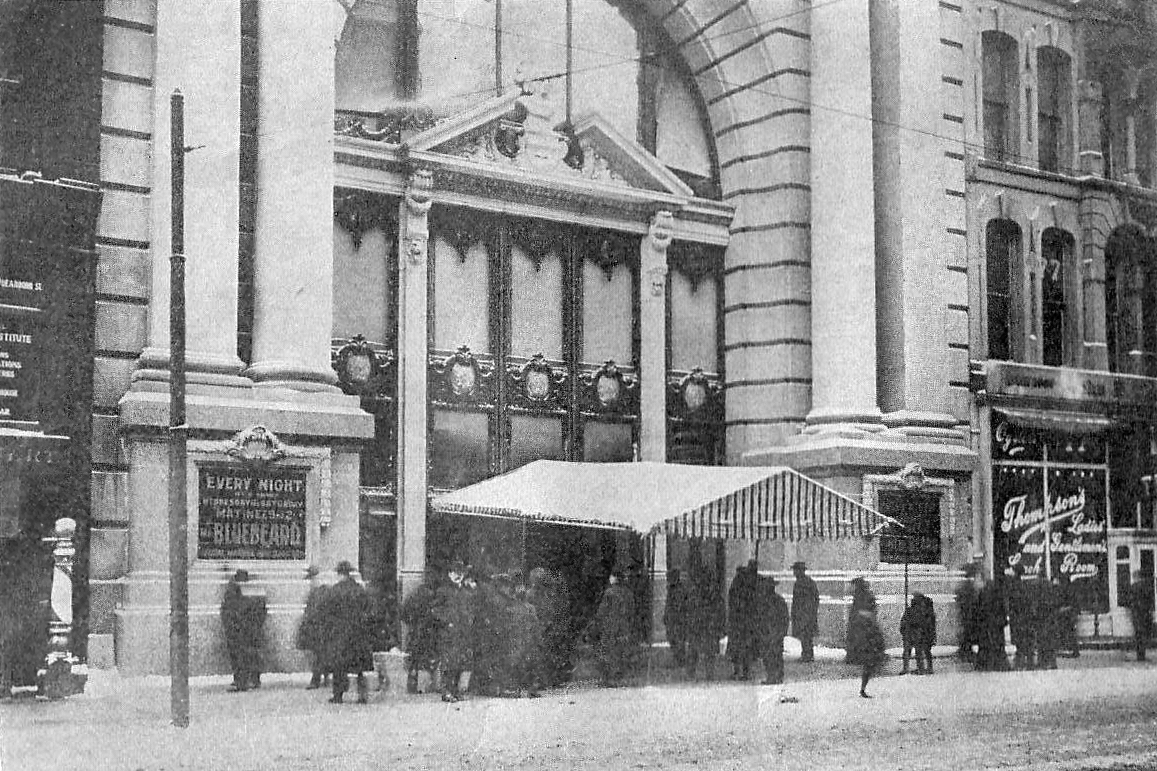
The Iroquois Theatre burned on 30 December 1903 in Chicago. Bill Cosgrove, in Chicago’s Forgotten Tragedy p. 99, puts the dead at 602. The draft in the Horan corpus says more than 600. This file prefers Cosgrove’s figure.
James J. Horan was Third Assistant Fire Marshal that day — not chief — and was on the scene. The Chicago Tribune of 31 December 1903 (p. 3) recorded the firemen’s work. He would not take the brigade until 1906. He died seven years later at the Union Stock Yards, not here.
What we can clock
- The second act of Mr. Bluebeard opened before a holiday standing-room audience of more than 2,100 patrons (capacity 1,602).
- An electric stage arc lamp sparked and ignited an untreated muslin border drop curtain above the stage-left fly gallery.
- Stagehands threw canisters of "Kilfyre" dry-powder extinguisher with zero effect on flames twenty feet overhead. The stage manager ordered the asbestos drop curtain lowered, but it caught on an iron light reflector and jammed thirty feet above the stage floor.
- Cast and stagehands fled out the rear freight doors into Couch Place alley. The sudden rush of sub-freezing outside air created a blast furnace draft, hurling a fireball under the jammed proscenium curtain straight into the balcony and gallery.
- The audience stampeded toward exits in sudden darkness. Fleeing patrons encountered exit doors swinging inward against the crowd, ornate draperies hiding doorways, unfinished fire escapes in the alley, and padlocked iron accordion gates in the balcony stairwells.
- A stagehand ran to Engine Company 13 on Dearborn Street (the building lacked a municipal alarm box). Fire crews and Third Assistant Fire Marshal James J. Horan arrived on scene within minutes.
- The fire was contained within thirty minutes, but 575 people were dead inside the auditorium; subsequent hospital deaths brought the toll to 602.
Forensic failure points
- Combustible scenery: The house held hundreds of square yards of untreated canvas and muslin drops hung adjacent to unshielded open-arc lamps without spark guards.
- The jammed "asbestos" curtain: Advertised as an impervious fireproof barrier, the drop curtain snagged on an iron reflector; subsequent chemical analysis showed it was fabricated primarily of flammable wood pulp and cotton fiber rather than mineral asbestos.
- Wired-shut skylight vents: Two enormous stage roof ventilators designed to pop open automatically and vent smoke upward into the open sky were nailed and wired shut to prevent rain and drafts. Superheated gases had no avenue of escape except into the auditorium.
- Inward-swinging doors & locked bascule gates: Exit doors opened inward, trapping escaping crowds against the frames. Iron accordion gates in stairways had been padlocked to prevent cheaper gallery ticketholders from sneaking into high-priced orchestra seats.
- Absence of municipal fire systems: The theater possessed no fire alarm box connected to City Hall, no standpipe connections, no automatic sprinklers, and no charged fire hose reels on stage.
Safety legacy
The 602 deaths at the Iroquois sparked intense civic outrage and reshaped public assembly regulations worldwide:
- Panic exit devices: Prompted the invention of the "panic bar" (push-bar hardware) by Carl Prince and Henry DuPont, allowing secured exit doors to release instantly under the pressure of a rushing crowd.
- Mandatory outward-swinging exits: Building codes across the United States and Europe were amended to require all doors in public assembly buildings to swing outward in the direction of egress.
- Proscenium firewalls & automatic smoke exhausts: Enacted requirements for steel-framed, fire-resistant proscenium curtains and counterweighted stage roof skylights with fusible links that release automatically upon heat detection.
- Clear aisleways & emergency lighting: Banned locked intermediate gates, decorative door draperies, and required exit corridors and signs to be wired on independent electrical circuits.