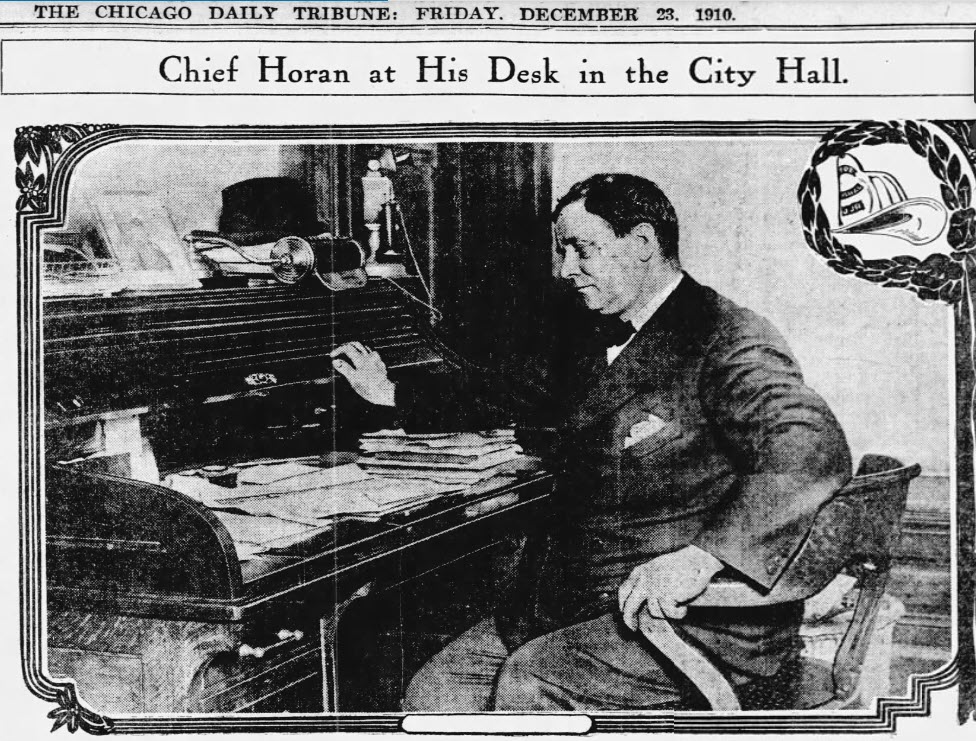
Early life
Chicago held him from the first. Irish parents, city schools, and a boyhood spent chasing horse engines down the street: that is the opening we can warrant. Two calendars still contest the May day in 1859. The Family Book tree writes 10 May. The Wikipedia draft writes 29 May. This file will not choose.
In 1881, at twenty-two, he entered the department as a water-supply driver. The next quarter century is a climb without a leap — pipeman, lieutenant, captain, assistant marshal — until the city put the whole brigade in his hands. About 1886 he married Katie A. Ryan. She died in 1895 and was laid at Calvary. On 21 October 1903 he married Margaret Ellen Mahoney. Four children were living when he was killed. The house stood at 722 Ashland Avenue, near Twelfth Street, later Roosevelt Road. He was a Catholic and a Knight of Columbus.
Iroquois, 1903
Winter’s last days of 1903 found him Third Assistant Fire Marshal — not chief. When the Iroquois Theatre burned on 30 December, he was on the floor with the first senior officers the department could put there. The deadliest theater fire in the United States followed. Bill Cosgrove later set the toll at 602. The Chicago Tribune of 31 December recorded the work of the firemen. This record does not retry the house. The thin event page waits on sources that are not yet on disk.
Chief, 1906–1910
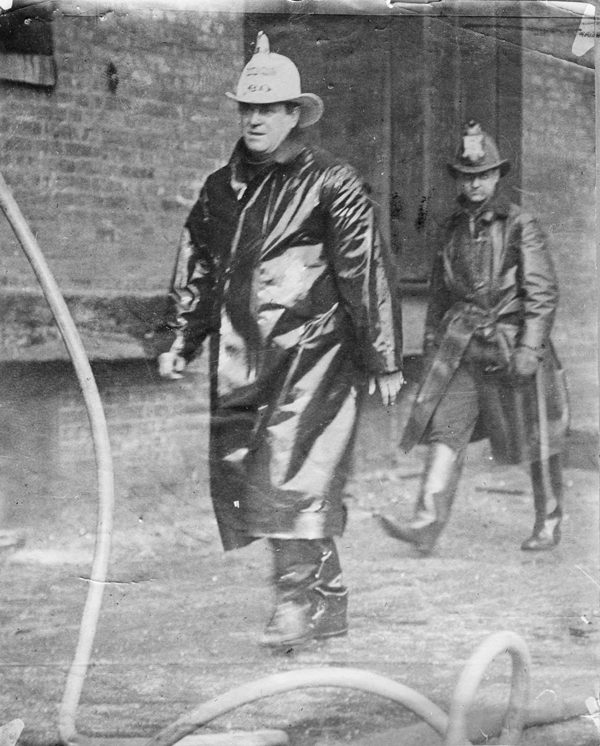
Mayor Edward Dunne named him Fire Marshal in 1906, after John Campion. He was forty-seven. Mayor Fred Busse kept him the next year. Campion had followed William H. Musham; Musham is an earlier chief, not Horan’s predecessor.
Four years of command meant new houses, new iron, and companies pushed into industrial ground. Engine Companies 101 through 117 and Truck Companies 30 through 34 were organized in that span. Merchants and insurance men backed the upgrades. A Tribune editorial called him an “implacable enemy of politics” — their phrase, printed then, cited here. He spent the same years asking the city for high-pressure water in the Stock Yards. The Council did not fund the mains.
Cherry, 1909
In November 1909 the state asked Chicago for men and gear at Cherry, Illinois. Horan went by special train with eleven veterans, Draeger oxygen helmets, deluge hose, and chemical apparatus. The Chicago squad pumped hundreds of gallons of water per minute down the burning shafts and entered the toxic galleries. Twenty-one miners were brought out alive on the seventh day. Two hundred fifty-nine miners died. The full forensic record sits on the Cherry Mine disaster event page.
Stock Yards, line of duty, 1910
On the morning of 22 December 1910 he stood before the City Council and asked again for those high-pressure mains. The Council adjourned without acting. Hours later he was dead under a packinghouse wall.
About 04:00 a watchman found fire in the hide cellar of Nelson Morris Beef Plant No. 7. Companies came. Freight cars on the siding forced long hose lays. Hydrants had been turned down against freeze. Horan took command at 05:05. With Second Assistant Fire Marshal William J. Burroughs he set lines under the wooden loading canopy at the east door. Other men climbed the canopy to hit the upper windows. The tracks left them no other platform.
Lieutenant Joseph Mackey saw the brick wall bow, gave warning, and jumped. Ten or twelve jumped with him and lived. Those under the canopy had no path. Six stories of masonry came out. The canopy went under. Horan and twenty of his men were buried. He was fifty-one. Twenty-one Chicago firefighters and three civilians died. It remains the department’s deadliest hour.
Command passed to First Assistant Charles Seyferlich. Late that night an ammonia tank blew the roof off Warehouse No. 6. Mayor Busse spent hours in the wreckage; Seyferlich pulled him clear of flying brick. Railroad derricks and steam shovels worked about seventeen hours before they uncovered the chief. CFD historian Bill Cattorini, speaking to CBS Chicago in 2010, said the body was on its knees, arms folded, facing the ruins. Margaret was first told he had been hurt. She collapsed when the recovery was named.
The full clock and the working roll of the twenty-one sit on the yards event page and the Fallen 21 roll. This file will not invent the other lives.
Funeral / the men
Chicago stopped for him. Busse called the Council and named fifteen aldermen to honors and relief. On 26 December a horse-drawn caisson left the Ashland Avenue house. His white leather helmet sat on the flag. The Tribune called the cortege a civic pageant. Tens of thousands stood in the cold. Archbishop James Quigley said a Requiem High Mass at Holy Name Cathedral. They buried him at Calvary Catholic Cemetery in Evanston.
A public fund raised $211,000 for widows and children. When trustees tried to pay only interest, the widows sued and won the principal.
Burroughs died on the same canopy line. Captain Patrick E. Collins and Lieutenants Herman G. Brandenburg, Edward J. Danis, and William G. Sturm are named in the contemporary lists. The rest of the twenty-one wait on the roll, labeled working until stone and 1910 papers confirm every spelling. Two leather helmets later entered the Chicago History Museum. The National Fallen Firefighters Foundation keeps him on the Roll of Honor. Find a Grave records the Calvary plot.