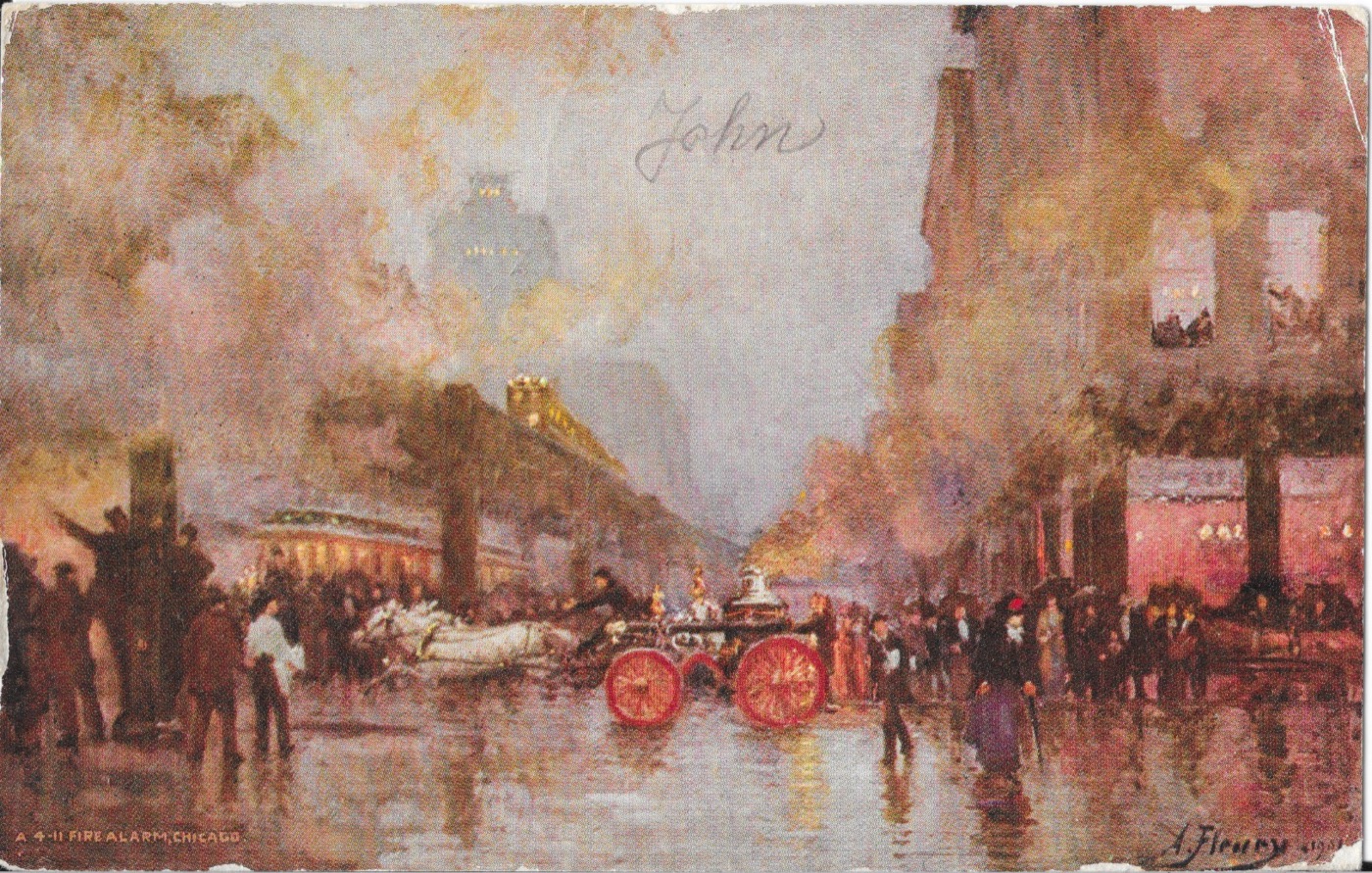
The Horan Archive keeps Chicago’s fires as a human record: what failed, who stood in the street, and what the papers said the next morning. It begins with one chief and the three fires that mark his life.
Chicago Fire Department, postcard front, 1914. Public domain via Wikimedia Commons.
Featured investigations
Three events from the same life. Only these. No other disasters this campaign.
What the catastrophes forced into the pipes, the apparatus, and the law. Only what is sourced on disk.
Water infrastructure
High-Pressure Stock Yards Mains
Between 1904 and 1910, engineering studies and Chief Horan persistently petitioned the City Council for high-pressure water mains throughout the Union Stock Yards. On the morning of 22 December 1910 — hours before the collapse that killed him — Horan made a final appeal to the Council. They adjourned without action. The disaster forced the municipal overhaul into the pipes.
High-pressure mains
Water supply
Cosgrove pp. 132–135
Apparatus & rescue
Oxygen Smoke Helmets
Horan took eleven veteran Chicago firefighters and Draeger oxygen helmets to the burning Cherry Mine shafts, pumping hundreds of gallons of water per minute down the shafts and penetrating toxic galleries to rescue twenty-one trapped miners after seven days. The deployment accelerated breathing apparatus adoption across the brigade.
Breathing apparatus
Cherry Mine rescue
Illinois BLS 1910
Building codes
Outward Exits & Panic Hardware
The 602 deaths at the Iroquois Theatre exposed bolted exit gates, inward-opening doors, and blocked stage vents. The tragedy forced nation-wide revisions in public assembly codes: mandatory outward-opening exit doors equipped with panic push-bars, fireproof proscenium separation, and automatic stage smoke exhaust.
Panic hardware
Exit regulations
Cosgrove p. 99
Buy the books
These writers did the labor. Buy their books so they are paid. This site is a door into their work, not a replacement for it.
Chicago’s Forgotten Tragedy
Bill Cosgrove · AuthorHouse, 2010 · ISBN 978-1-4520-7938-7. The yards, the 21, Cosgrove’s 602 at Iroquois.
Matthew Drew · CreateSpace, 2014 · ISBN 978-1-5008-1677-3. Horan, Busse, Comiskey. A portion of proceeds is pledged to the Ende, Menzer, Walsh & Quinn Retirees Widows and Children’s Assistance Fund.
Chicago fire history. The record of James J. Horan — called Big Jim — and the fires that mark his life: the Iroquois Theatre, the Cherry mine shafts, and the Union Stock Yards wall that killed him and twenty of his men. Wikipedia is a source, not the voice. Reverence is allowed. No saint, blessed, or martyr claim.